Stablecoins have become the consensus breakout use case for crypto. Far fewer people have asked the more useful question: if that thesis is right, which on-chain instrument actually captures the value it creates, and which ones merely sit adjacent to it?
This piece argues that the answer runs through a specific, often-overlooked corner of DeFi: the Curve ecosystem, and the two locked claims that sit at its center, CRV (vote-escrowed as veCRV) and CVX (vote-locked as vlCVX).
Not because Curve is the newest or fastest-growing venue (it isn't), but because it has been stress-tested through multiple bear markets and kept delivering throughout. It has the one thing most competitors lack: a mechanism that routes actual protocol revenue to token holders as a direct, protocol-level entitlement rather than as a discretionary buyback or nothing at all.
CRV and CVX are two ways into that same ecosystem, with different shapes; the piece treats them as two legitimate front doors rather than ranking one over the other, while being clear that CVX, as a derivative layer built on top of Curve, carries both extra risk and extra potential.
The claim is conditional, and the conditions are the whole risk. State them up front:
- if stablecoin flows keep routing through permissionless AMMs, and
- if Curve keeps capturing meaningful volume from those flows — in absolute terms, not share,
- then the Curve ecosystem is one of the cleanest on-chain routes to capture it.
Both conditions are examined in the analysis that follows, rather than hidden.
Part 1 — The landscape
We'll trace the anatomy of a stablecoin through three distinct angles: what powers it, where it trades, and where its value ends up. They stack toward a single question: who, if anyone, can capture the value it throws off.
What powers it — collateral & yield
Stablecoin has quietly become a word that covers several economically distinct species: reserve-backed, earning reserve interest; over-collateralized debt against crypto, earning borrower interest; and synthetic delta-neutral, earning funding/basis.
They trade at the same $1, but the income behind each comes from a different engine. It's worth seeing the distinction once, because it's what reveals that Curve's own crvUSD is a debt-based dollar earning borrower interest, a fact that matters when we get to how Curve generates revenue.
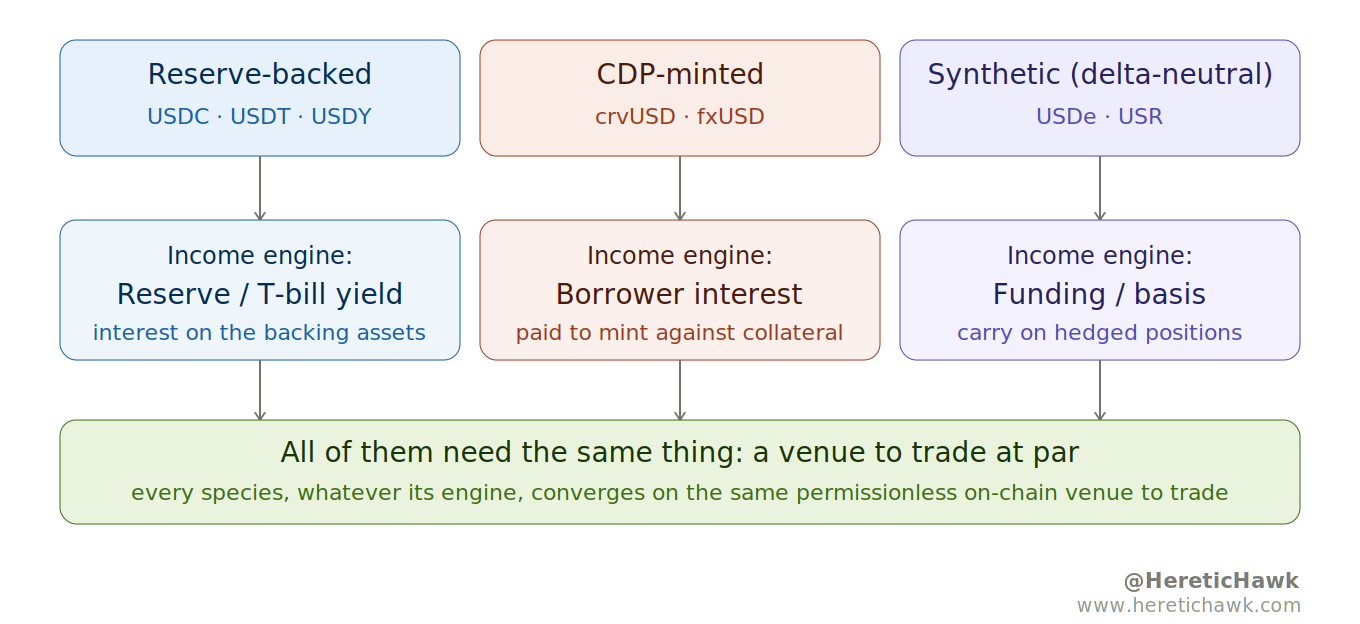
The reason to care about the whole taxonomy, not just the institutional dollars, is that a genuine adoption wave lifts all of it. If frameworks like the U.S. CLARITY Act formalize how stablecoins and tokenized assets are treated, the institutions waiting on the sidelines gain the certainty to issue and hold at scale.
The result isn't just the established players scaling up, but a proliferation of new stablecoins, reserve-backed and crypto-native alike, competing for the same on-chain liquidity. That proliferation is the demand this thesis is about.
Where it trades — Markets & Liquidity
Whatever engine sits behind a stablecoin, every one of them needs the same thing to be useful: a venue where it can be swapped, at par, against other dollars. That need is what puts the venue central to the story, though not the whole of it. And not every dollar reaches the same kind of venue.
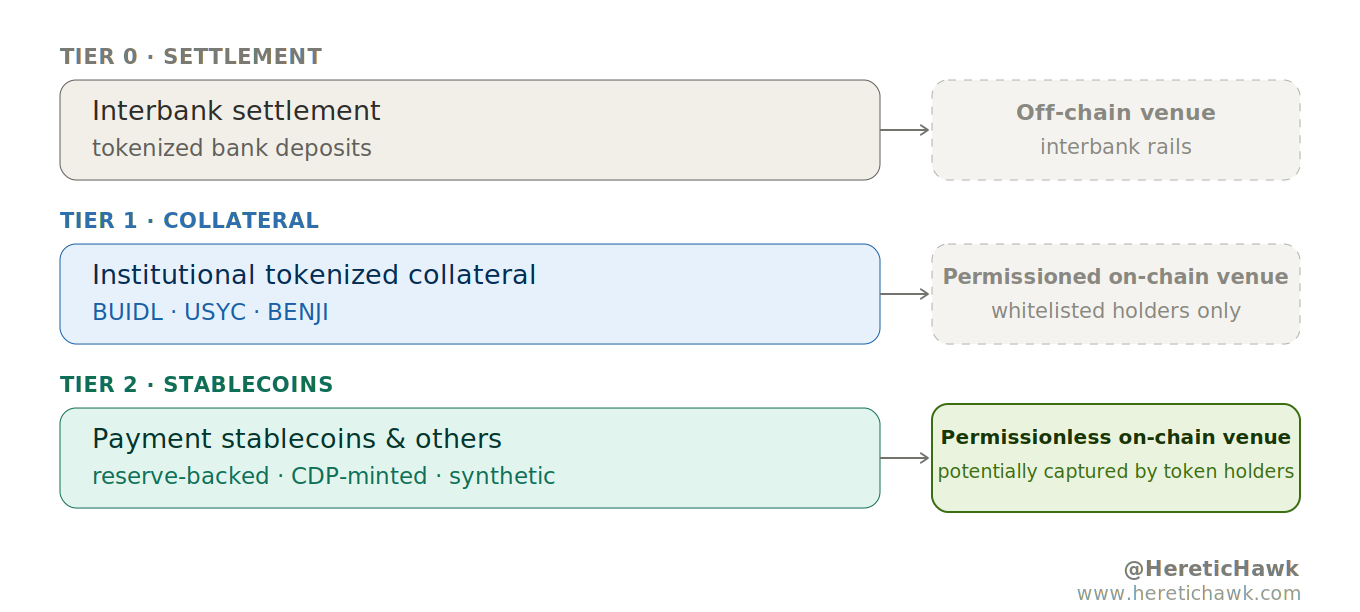
The stack sorts into three tiers, and what separates them is where each one trades.
- Tier 0, interbank settlement, moves tokenized bank deposits over closed rails that never touch a public market.
- Tier 1, the institutional tokenized collateral behind many stablecoins, lives on-chain but behind a gate: only whitelisted holders can touch it, and it changes hands through issuance and private desks, not an open market.
- Only at Tier 2, the stablecoins themselves, does a permissionless on-chain venue exist: a market anyone can trade on, and therefore the only tier where value can reach ordinary token holders rather than banks or issuers.
The counterintuitive lesson of the stack is that institutional weight runs inverse to on-chain capture. The tiers with the most traditional-finance heft (the banks at Tier 0, the asset managers issuing Tier 1 collateral) hand DeFi the least.
The value that DeFi can actually touch concentrates at the stablecoin tier and its permissionless venue: the open, commoditized edge of the picture.
That single distinction, permissioned versus permissionless, is why this thesis lives at the permissionless venue and nowhere else in the stack.
Where the money goes — Flows & Accrual
The third angle is the one that matters to anyone trying to capture the yield a stablecoin throws off: once it earns its income, where does that income actually land?
Take the reserve-backed species first, as the clearest case: its yield is the interest thrown off by the Treasuries behind it. Where that yield lands depends entirely on how the token is designed, and only some destinations are reachable by holding a token.
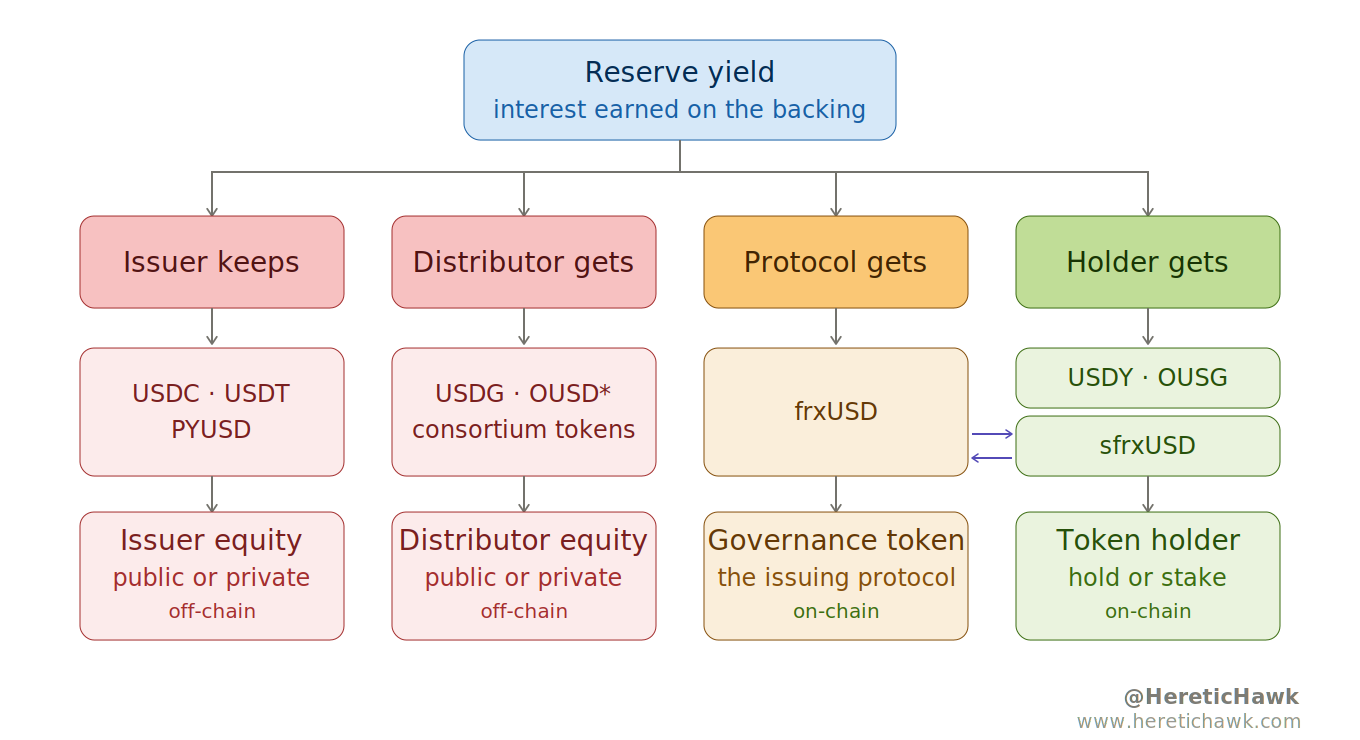
The yield can land in four places, and only some resolve to a claim on the yield itself. It can go to the issuer or a distributor, where it leaks off-chain to the company, reachable then only as an indirect equity claim on the enterprise. Or the yield can go to the protocol or the holder, where it stays on-chain and the income itself is the thing one could arguably own, directly.
The holder branch splits two ways: the yield can accrue in the token as it's held, or the base can stay a flat dollar while the yield lives in a separate staked token the holder converts into. That stake decision is the switch between the two columns.
That distinction is the whole game: value that leaks off-chain into equity, versus value held directly on-chain. And it gets sharper still for the dollars that carry no reserve.
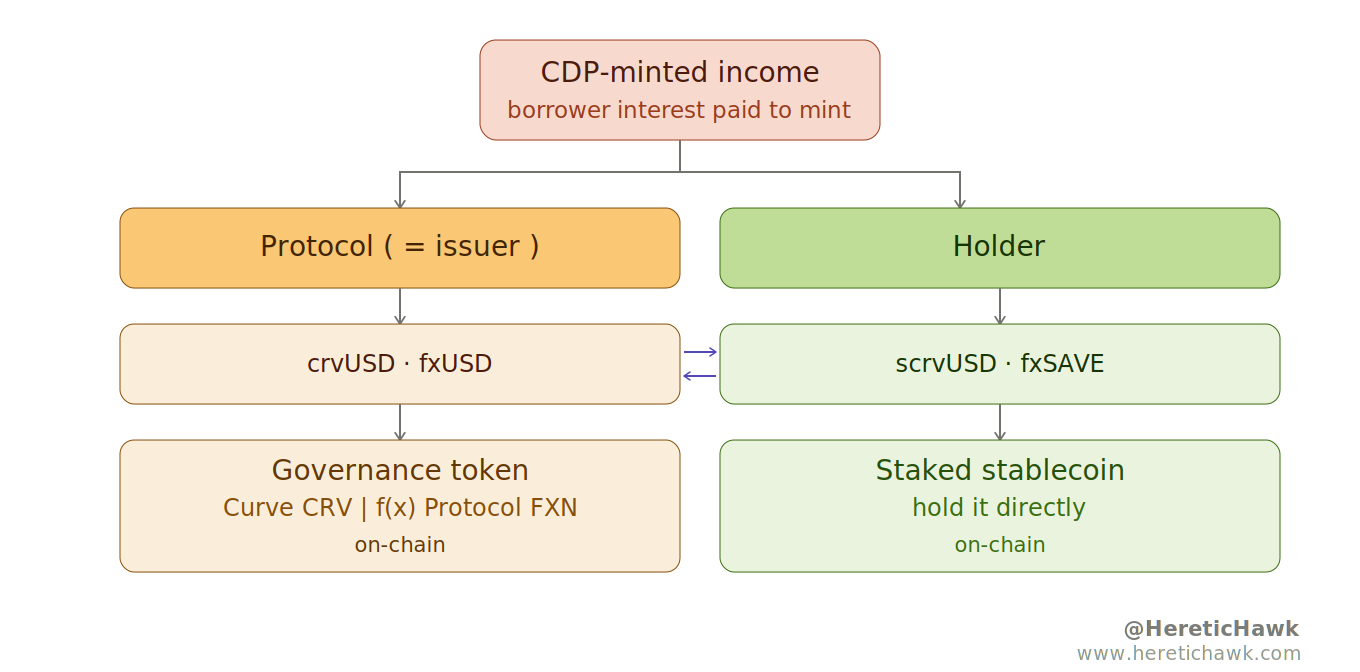
The CDP-minted dollars are worth a diagram of their own, because their income lands in fewer places. A CDP dollar has no reserve behind it, so there's no reserve yield and no separate issuer to pocket it: the protocol that mints the dollar is its issuer, which collapses the four destinations to just two.
The borrower interest can flow to the protocol, reaching holders of its governance token, or to the holder, who captures it by staking the dollar into its savings form. How directly it lands depends on the design: some protocols route it through a buyback, others as a redeemable claim, as crvUSD does into veCRV.
Notice what the two figures do to the naive version of the thesis. "Institutions are adopting stablecoins, so buy stablecoin exposure" runs straight into the fact that for reserve-backed dollars, in half the destinations, what's reachable is at most an indirect equity claim on the company, not the yield itself, and often not even that.
Being right about adoption is not the same as capturing it. And the one branch that clearly is a direct on-chain claim, borrower interest reaching veCRV, previews exactly how the Curve thesis works. That's why the design of the vehicle matters more than the size of the trend.
The synthesis
The three angles converge on one fact: the value a stablecoin throws off can structurally be captured, on-chain and as a direct claim, only at the permissionless venue where it trades, and only through very few protocols. That's what turns the venue into the whole question. And what the venue can capture depends on two kinds of demand the trend creates:
- Volume — dollars being swapped, which generates trading fees.
- Depth demand — issuers needing deep liquidity, which on incentive-based venues generates vote incentives (colloquially, "bribes"): payments to those who can direct emissions toward a pool.
An institutional adoption wave doesn't just add volume to existing stablecoins. It multiplies how many compete for liquidity. More stablecoins trading means more swap volume, and every new issuer needs depth, which drives vote-incentive demand toward whatever venue can provide it.
So the venue that (a) captures a meaningful volume of that flow and (b) has a mechanism to route it to token holders is where the thesis becomes tangible.
That second criterion is where venues differ in a way that matters. What sets Curve apart is how it returns value: it distributes actual protocol revenue to lockers as a direct claim, rather than through the increasingly common buyback, which returns value only indirectly, through price.
That is the entire reason this thesis points where it does.
Part 2 — Why the Curve ecosystem
The stablecoin trend creates two kinds of on-chain demand: volume and depth. Curve is engineered to capture both, and to channel them to token holders.
The mechanism is vote-escrow: locking CRV earns a share of protocol revenue plus the right to direct where emissions flow. That direction-setting is what makes the whole economy turn, because anyone who wants their pool to receive emissions will pay lockers to vote for it.
But Curve is no longer only an exchange, and that turns out to be central to the thesis rather than a footnote. So before the vehicles, it's worth seeing the full surface of what Curve now monetizes.
Curve's revenue streams: beyond trading fees
A pure AMM earns one thing: trading fees. Curve's ecosystem generates value from four related streams, three that flow as protocol revenue toward veCRV, and a fourth delivered directly to voters:
- Trading fees — the exchange vertical. Roughly half of swap fees route to veCRV lockers (the rest to LPs).
- crvUSD issuance income — the borrower interest Curve earns on its own minted stablecoin. Curve doesn't just route dollars. It issues one, and collects interest from everyone who mints it.
- LlamaLend — interest and liquidation-AMM fees from Curve's lending markets, built on the same LLAMMA engine as crvUSD.
- Vote incentives — the fourth stream, and structurally different from the other three: these aren't protocol revenue at all, but payments made directly by third parties to the holders who control emissions votes. They don't pass through the protocol itself; they land straight on lockers.
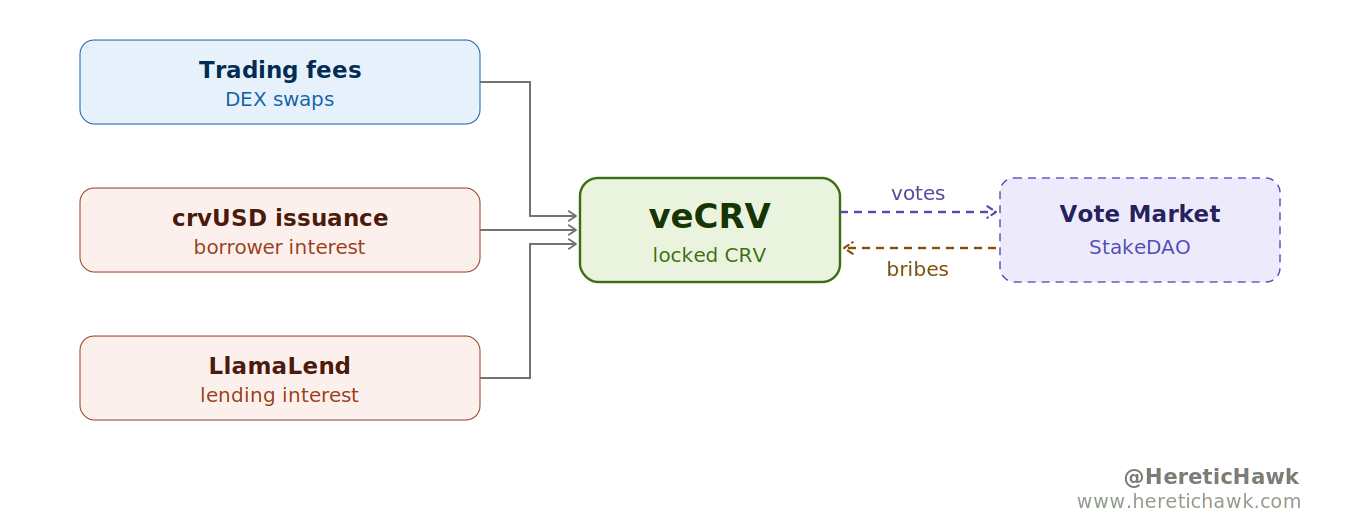
The diagram makes the shape explicit: three streams flow inward to veCRV as protocol revenue, while the vote-incentive relationship runs sideways to a vote market, where veCRV directs votes and receives bribes back. So a single locked position captures value from two directions at once: what the protocol earns, and what outsiders pay to steer it.
This multi-stream structure carries three implications worth drawing out:
First, issuing a stablecoin is a structural edge a pure exchange does not replicate, an entire revenue vertical a venue without its own dollar simply doesn't have.
Second, it runs lending markets of its own, another vertical a pure exchange lacks, though a more common one than issuing a dollar.
Third, the mix is shifting. Trading fees are still the majority of veCRV revenue, with crvUSD a smaller but growing share. As crvUSD issuance and LlamaLend lending scale, the issuance-and-credit verticals may eventually rival trading fees, even if they haven't yet.
The importance for this thesis: Curve captures stablecoin adoption through more than one door, which partially insulates it from losing pure routing share to a rival venue. The focus here remains volume, fees and vote incentives, but the thing to carry forward is that Curve is a decentralized exchange plus an issuer plus a lender.
The front doors
The ecosystem offers a spectrum of ways into the thesis, running from a durable base claim to a leveraged route in, with more exotic layers beyond.
They are not a ranking from best to worst — they are different risk/reward shapes on one underlying thesis, serving different ends.
The two that anchor the spectrum, CRV and CVX, are best understood as two legitimate front doors rather than a first and second choice.
The direct claim: CRV locked as veCRV
Locked CRV becomes veCRV, the direct claim on everything described above: all of Curve's protocol revenue streams (trading fees, stablecoin issuance income, and lending-market interest) plus the right to direct emissions and collect the vote incentives paid for that right.
The two kinds of income have different drivers:
- Vote incentives are competition-driven and discretionary, often heaviest while an issuer is bootstrapping a pool, with a recurring floor from established protocols defending the gauge weight their liquidity depends on.
- Protocol revenue is usage-driven, generated automatically whenever the venue is traded on or borrowed from, rising and falling with on-chain activity rather than with anyone's decision to pay.
The cost of the CRV door is the lock, up to four years. Over a short horizon that illiquidity is a cost; over the multi-year structural flow the thesis assumes, it is alignment, capital committed across the period over which a structural shift like this could actually unfold.
The lock has a second effect, too: it sorts holders by conviction. Anyone without a multi-year view is filtered out by design, which is a feature.
The leveraged layer: CVX locked as vlCVX
Convex sits on top of Curve. It aggregates CRV, locked as veCRV, to control a large share of Curve's total voting weight, and in doing so became the place where voting power concentrates.
Vote-locked CVX becomes vlCVX, a 16-week lock notably shorter than veCRV's up-to-four-years, and carries the vote-incentive stream: the payments made by anyone who wants to steer Curve emissions toward their pool.
CVX is a derivative layer on the same underlying as CRV. And being a derivative layer cuts both ways. It adds risk (extra smart-contract surface, dependence on Convex maintaining its veCRV position, and a fee exclusion worth weighing) and it adds benefits (leverage, concentrated steering power, and a far shorter lock).
It is not merely "CRV with leverage." It offers two things the direct route does not:
First, leveraged exposure to the vote-incentive stream. vlCVX carries higher beta and more directionality: its sensitivity is greatest when depth demand is most intense, often when new issuers bootstrap liquidity, even though established pools keep paying to defend their weight between waves.
Second, leveraged steering over Curve itself. Because Convex controls a large block of aggregated voting weight, vlCVX is not only bribe income; it is influence over Curve DAO decisions: which pools get emissions, and the governance choices that shape the protocol.
For an issuer, a protocol, or any large holder who wants to shape where liquidity flows rather than merely earn from it, that control is the point, capital converted into governance power over the single venue this whole thesis rests on. It's a genuinely different rationale than yield, and one that can lead to CVX even when the CRV door was open.
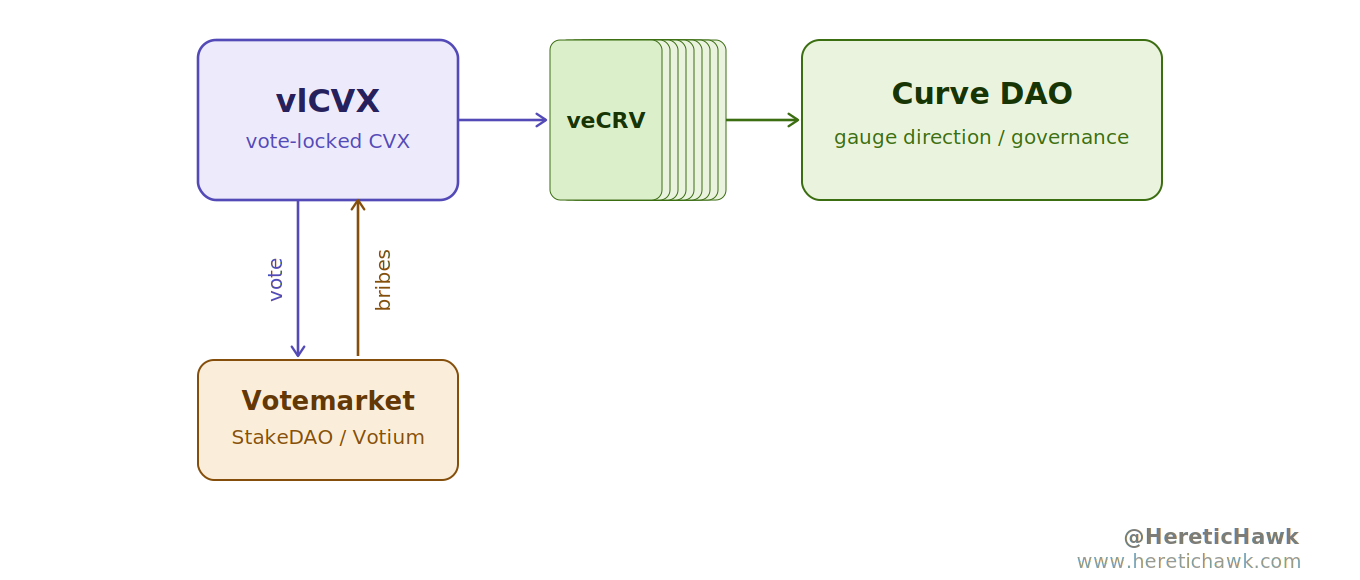
The diagram shows the two side by side, and they carry leverage of different kinds:
- One vlCVX position commands several times its weight in Convex's aggregated veCRV block, cast into Curve DAO to set gauge direction and governance, a structural leverage fixed by the aggregation ratio.
- Separately, the holder directs that vote through a vote market and is paid bribes in return, directly, without routing through the block: leverage of its own, but market-set, running smaller than the governance multiple.
Both are leveraged; the steering structurally, the income by its market.
The honest counterweight: CVX does not capture the veCRV fee stream. Those fees route elsewhere within the Convex system, not to vlCVX.
So CVX leverages both the competition-driven bribe income and the power to steer Curve, and forgoes the usage-driven fees. The tradeoff at this door: leveraged income and control, at the cost of the fee stream.
The ladder beyond the two doors
As emphasized throughout, CRV and CVX are two front doors into the ecosystem, but the ecosystem runs deeper than them. A whole tier of protocols builds on top of it: stablecoin issuers, yield layers, and structured products, some thinner and more exotic than others.
Mapping them is beyond the scope of this piece (material for a closer look in the future), but their existence is the point. The Curve ecosystem is deep enough that others build entire businesses layering on top of it, which is itself a measure of how much value flows through the base.
Part 3 — The competition, honestly
A thesis is only credible if it survives its strongest counterargument.
The competition that matters here, as long as swap volume remains the larger source of income, is over the core axis: the stablecoin swap and incentive economy.
The issuance and lending verticals face separate rivals that deserve their own treatment, a subject for another piece should those verticals scale to warrant it.
On this axis, the counterarguments split into two very different kinds:
The real alternative: Aerodrome (AERO)
Aerodrome (now consolidating with Velodrome into a unified, cross-chain Aero that expands to Ethereum mainnet and Circle's Arc chain) runs the same vote-escrow revenue-sharing model as Curve in its purest form, routing 100% of swap fees to veAERO lockers.
Several of the highest-revenue protocols (Hyperliquid, Uniswap, and others) return value to holders indirectly, through buybacks or burns a holder can't redeem against. That puts Aerodrome in the very small club of venues distributing fees as a genuine direct claim.
Combined with its Circle/Arc alignment, which ties it straight to the institutional-stablecoin routing boundary this thesis is about, that's what makes it the one competitor sharing the exact value-capture design that defines the CRV thesis — the counterargument that can't be waved away.
The honest framing is a two-horse race: CRV as the multi-chain incumbent with some of the deepest stablecoin pools and a long, stress-tested track record, versus AERO as the fast-growing challenger with cleaner fee routing and institutional-rail positioning, now shedding its old single-chain concentration through the mainnet expansion.
The choice between them is incumbent breadth versus newer-venue growth, both with the same underlying capture mechanic. Any honest CRV thesis has to concede AERO is a genuine contender, not a footnote.
The volume threat: Uniswap and Fluid
Uniswap and Fluid are a different kind of competitor. They may well win volume: Fluid has taken major stablecoin DEX share, Uniswap remains the largest DEX overall.
But neither returns value the way Curve does: Uniswap routes its fees into a burn, so value reaches holders only indirectly through reduced supply, with alignment questions of its own that lie beyond the scope here. Fluid runs a revenue-triggered treasury buyback the team was able to pause operationally, without a holder vote; reasonable call or not, it was unilateral.
There's also a reason to discount the raw volume: Fluid began as a lending protocol, and its DEX liquidity is borrower positions repurposed as trading capital, so part of its headline volume likely reflects internal rebalancing from that lending business rather than independent swap demand.
And there's a vertical none of these venues share: Curve issues its own stablecoin. Fluid shares the lending vertical, but not the issuing one, a stream sitting entirely outside the swap-volume fight these competitors are in.
None of this means Curve wins (Fluid taking share is a real risk, treated below), but winning volume and rewarding holders are different achievements, and the vehicle should be judged on the second.
The permissionless premise
Strip away the token comparison and the real risk is upstream of all of it: the venue assumption itself. The thesis holds only if stablecoin routing keeps happening on permissionless AMMs where Curve can capture it. Two things cut against that.
First, institutional-size flow increasingly routes through private RFQ/OTC desks rather than public pools, which generates neither fees nor depth demand.
Second, the upper tiers (interbank settlement and institutional tokenized collateral) bypass permissionless AMMs entirely by design. If the stablecoin wave routes around permissionless venues, the whole stack is impaired together, no matter how elegant the value-capture design.
Part 4 — Signals to watch
No thesis is worth much if you can't say what would change your mind. Five questions track whether this one is playing out:
- Overall on-chain stablecoin volume — the premise itself: is stablecoin activity actually migrating on-chain and growing? Everything downstream assumes it is, and absolute capture can rise even as share slips.
- Actual share of that volume — is Curve's share increasing, flat, or shrinking, and against whom? Share lost to a venue that doesn't reward its holders barely dents the thesis; share lost to another direct-claim venue is the one that matters.
- Multi-vertical revenue mix — are issuance and lending income growing relative to trading fees? That would make swap volume less decisive for Curve specifically.
- Stablecoin gauge formation — is gauge activity keeping pace with rising overall volume? If not, Curve may be losing its grip as the default liquidity layer for stablecoins.
- Vote-incentive market — are total bribe volume and value per vote rising alongside the new gauge activity? If not, the new gauges may lack the well-funded projects that actually pay to compete.
Part 5 — Conclusions
Step back from the metrics and one distinction reorganizes the whole competitive picture: who the competition really is. Curve can concede volume share to a rival and still come out ahead for its holders, because a venue that captures flow but returns nothing to its holders isn't competing for what matters here.
The only rival that genuinely threatens the thesis is one that also grants a direct claim on what it earns, which today means Aerodrome and little else. Everyone else can win the swaps and still never touch what a veCRV or vlCVX holder actually owns — a direct claim on the revenue the stablecoin wave generates.
And the caveat that has run through the whole piece still stands: the macro thesis can be right while this particular ecosystem fails to capture it. Being right about stablecoins is not the same as owning the right vehicle. That distinction is what this entire piece has been built around.
Disclaimers and caveats
For informational and educational purposes only. This is not investment, financial or legal advice, nor a solicitation to buy or sell anything. It's an argument about where value-capture mechanics point, offered so you can reason about the vehicles yourself and reach your own conclusions. Do your own research, consult a qualified professional before acting, and note that the author may hold positions in the assets discussed and accepts no liability for decisions made in reliance on this piece.
Everything here is point-in-time as of publication and provided as-is, without warranty. Regulations, protocol mechanics, and revenue-sharing specifics vary by jurisdiction and shift over time, and any forward-looking views are speculative rather than guarantees, so treat the structural argument as the spine and re-verify the current details before acting. How different dollars get classified is a question for a securities lawyer in the relevant jurisdiction, not a conclusion to trade on.
Back to articles